
Overview
Kleidos on the M5Stack CoreInk
Kleidos turns the M5Stack CoreInk into a password manager: it keeps your passwords encrypted on the board and types them into your computer or phone over Bluetooth, after you unlock it on the board itself. The firmware costs nothing and asks for no account. There is nothing to install yet: version 0.1.0 is not released.
The same firmware runs on nine boards, and I recommend none of them over the others: this page says what the CoreInk does with it.
Updated
Kleidos on its own screen
Every recording here is of the CoreInk's own screen, with a demonstration vault on a development build. The same recordings are on the recordings page, beside those of the other boards with a tab there.
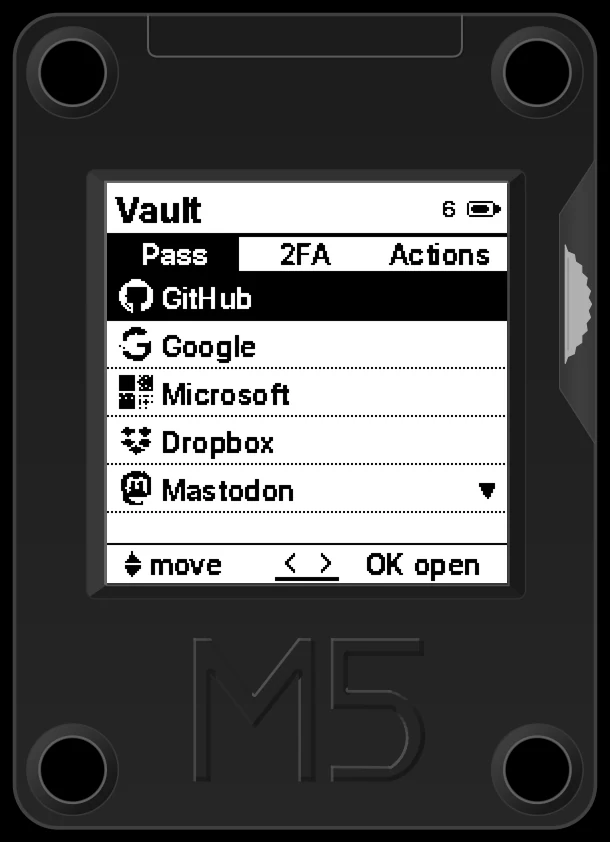
Each picture's badge says how I made it, and the legend of the badges explains every kind.
- Live from the device
What each control does
Each row quotes what the CoreInk itself shows for that control: on the pages it shows the first time it starts, or in the bar at the foot of its vault list.
| Control | What the board says it does |
|---|---|
| The wheel, turned | “move, adjust” |
| The wheel, pressed | “select, continue” |
| The wheel, held | “hold: type, dial PIN” |
| The side key | “side key: back, wake” |
| The top key | “top key: lock” |
- The wheel, turned
- What the board says it does: “move, adjust”
- The wheel, pressed
- What the board says it does: “select, continue”
- The wheel, held
- What the board says it does: “hold: type, dial PIN”
- The side key
- What the board says it does: “side key: back, wake”
- The top key
- What the board says it does: “top key: lock”
A hold is a press longer than 600 ms.
I will write a guide to every screen, board by board, once the interface stops changing.
The board: what it holds and how it keeps time
The vault is the same on every board. What changes with the board is how much it holds, how it keeps time for the one-time codes and where its backups go.
- Chip
- ESP32
- Input
- Wheel
- Screen
- 200×200
- Case
- 40×56 mm
- Capacity
- 90 credentials, 30 two-factor (2FA) codes
- Clock
- Battery-backed chip
- 2FA codes
- On as it comes
- Card slot
- No: backups go through the admin panel
What else is particular to the CoreInk
- It has no motion sensor, so its settings do not offer “Shake to lock”.
- On the classic ESP32 two Bluetooth protections cannot be on together: the controller refuses its accept list while the rotating private address is on. The CoreInk keeps the private address and, in the list's place, drops anything that is not paired as it connects.
- Its 4 MB of flash has no room for a second update slot or a signed bootloader, so it has no hardened build and is updated by re-flashing it whole.
What it draws from its battery
What the CoreInk draws in each state, as the measurements page prints it. That page says what each state is and how each figure was taken.
-
I give no battery estimate for it: nothing on it reads current, and putting the measurement system in its battery wire means opening the case. Its lock-screen clock, which is on by default, also wakes it every minute, so its sleep has to be measured as the charge used over an hour, not as a current read at one moment. I publish no unlock time for it yet.
- Asleep
- not yet
- Light sleep
- not yet
- Normal use
- not yet
- Wi-Fi
- not yet
- Bluetooth
- not yet
Switches itself off: it lets go of the line that holds its power on, and the board cuts its supply.
What it costs
Kleidos costs nothing: there is nothing to buy from the project and no account to make, and the firmware is free software under GPL-3.0-or-later. What you pay for is the board.
- Price
- US$29.90
- Listed by
- M5Stack's own store
- Product code
- K048
- Read on
- 1 November 2026
That is what the maker's own store asked on the day I read it, before shipping and taxes. Resellers set their own prices, and prices change.
Where the firmware stands
Kleidos is pre-release, at version 0.1.0: there is nothing to install yet, and the roadmap says what is left before the first release.
- Version
- 0.1.0
- To install
- Nothing yet: no release is published
- Hardened build
- Not available (4 MB flash)
I have not had the firmware or the cryptography reviewed by anybody outside the project; the security page says what you can and cannot check.