
Overview
Kleidos on the M5StickS3
Kleidos turns the M5StickS3 into a password manager: it keeps your passwords encrypted on the board and types them into your computer or phone over Bluetooth, after you unlock it on the board itself. The firmware costs nothing and asks for no account. There is nothing to install yet: version 0.1.0 is not released.
The same firmware runs on nine boards, and I recommend none of them over the others: this page says what the StickS3 does with it.
Updated
Kleidos on its own screen
Every recording here is of the StickS3's own screen, with a demonstration vault on a development build. The same recordings are on the recordings page, beside those of the other boards with a tab there.
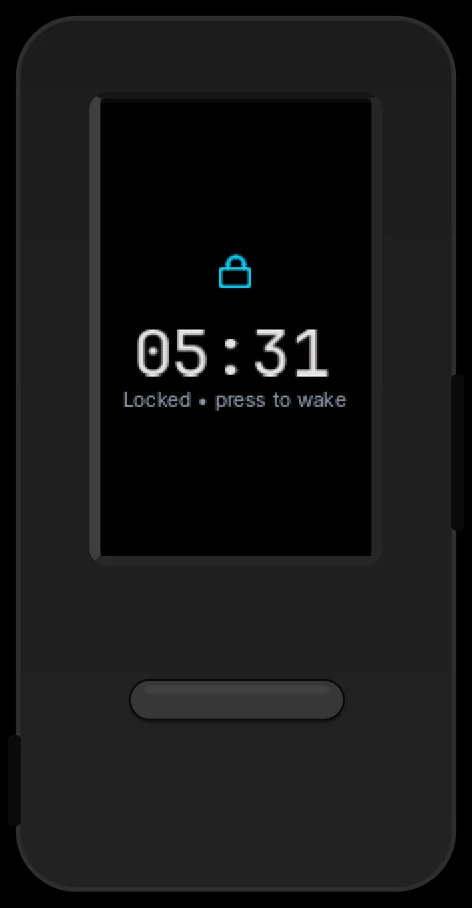
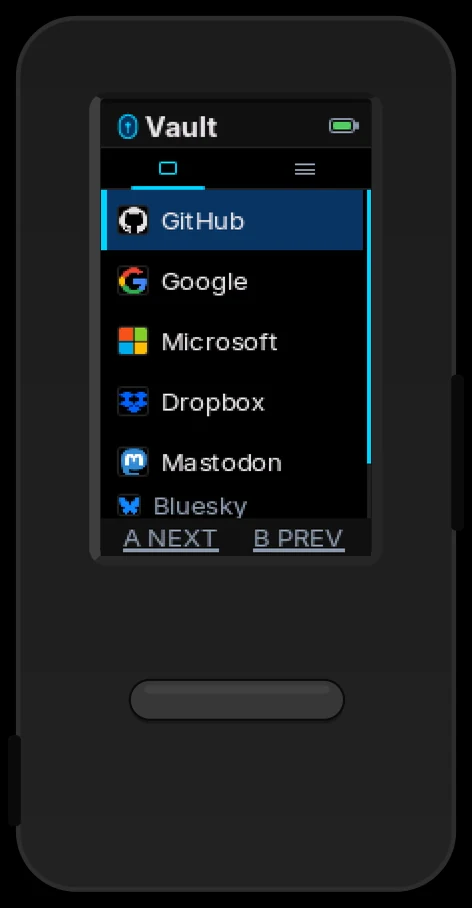
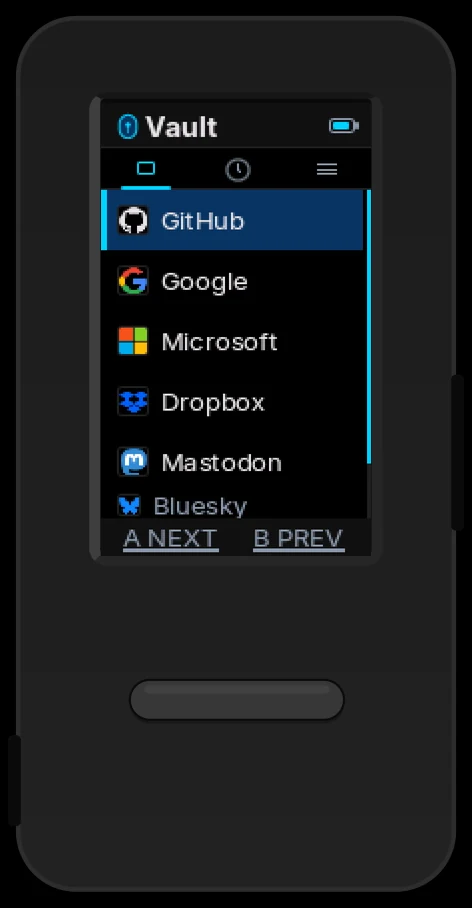
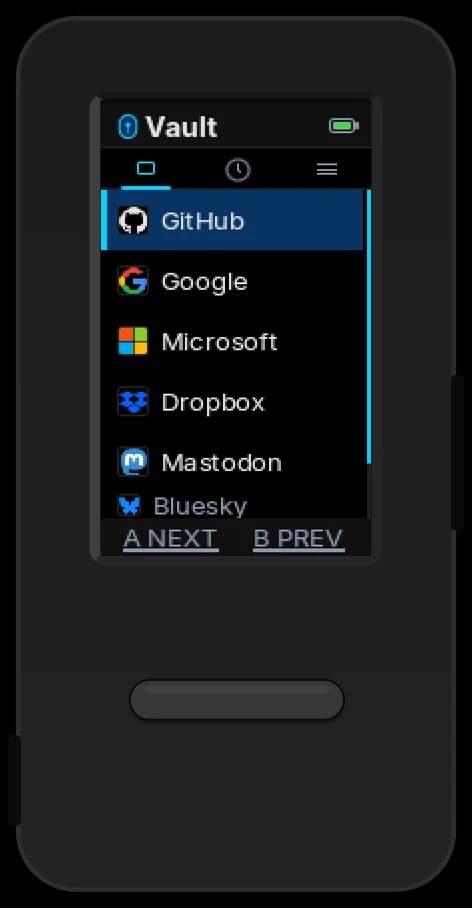
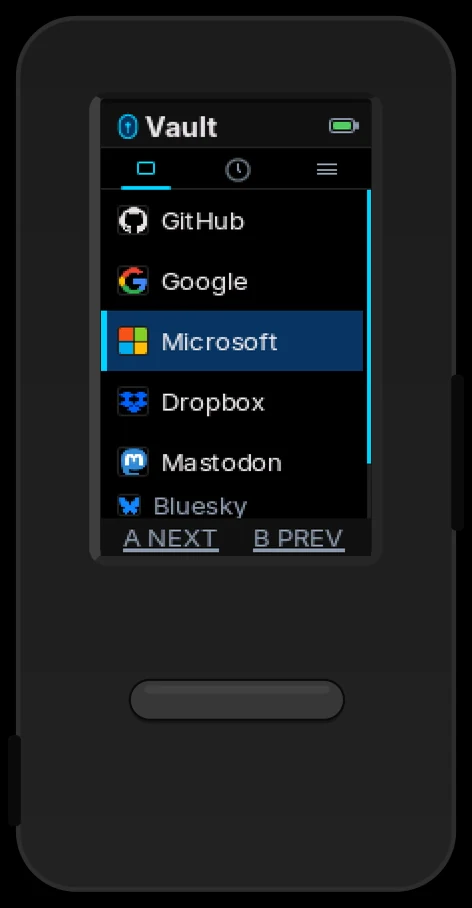
Each picture's badge says how I made it, and the legend of the badges explains every kind.
- Live from the device
What each control does
Each row quotes what the StickS3 itself shows for that control: on the pages it shows the first time it starts, or in the bar at the foot of its vault list.
| Control | What the board says it does |
|---|---|
| Button A, pressed (“big button below”) | “NEXT” |
| Button A, held | “OPEN”, “Hold A: PIN” |
| Button B, pressed (“small side button”) | “PREV” |
| Button B, held | “Hold B: back”, “PAGE” |
| The power button | “Power: lock” |
- Button A, pressed (“big button below”)
- What the board says it does: “NEXT”
- Button A, held
- What the board says it does: “OPEN”, “Hold A: PIN”
- Button B, pressed (“small side button”)
- What the board says it does: “PREV”
- Button B, held
- What the board says it does: “Hold B: back”, “PAGE”
- The power button
- What the board says it does: “Power: lock”
In the vault list a hold of B turns to the next page, because the list has nothing to go back to.
A hold is a press longer than 600 ms.
I will write a guide to every screen, board by board, once the interface stops changing.
The board: what it holds and how it keeps time
The vault is the same on every board. What changes with the board is how much it holds, how it keeps time for the one-time codes and where its backups go.
- Chip
- ESP32-S3
- Input
- Two buttons
- Screen
- 135×240
- Case
- 24×48 mm
- Capacity
- 250 credentials, 40 two-factor (2FA) codes
- Clock
- Internal, drifts through a sleep
- 2FA codes
- Off as it comes; when on, they need a time sync since the board last went to sleep
- Card slot
- No: backups go through the admin panel
What else is particular to the StickS3
- It has a motion sensor, so its settings offer “Shake to lock” and the shake's sensitivity.
What it draws from its battery
What the StickS3 draws in each state, as the measurements page prints it. That page says what each state is and how each figure was taken.
-
I give no battery estimate for it: its power controller reads voltages, not current, and putting the measurement system in its battery wire means opening the case. I publish no unlock time for it yet.
- Asleep
- not yet
- Light sleep
- not yet
- Normal use
- not yet
- Wi-Fi
- not yet
- Bluetooth
- not yet
Deep-sleeps with the chip still powered: its internal clock keeps counting, but drifts.
What it costs
Kleidos costs nothing: there is nothing to buy from the project and no account to make, and the firmware is free software under GPL-3.0-or-later. What you pay for is the board.
- Price
- US$21.50
- Listed by
- M5Stack's own store
- Product code
- K150
- Read on
- 1 November 2026
That is what the maker's own store asked on the day I read it, before shipping and taxes. Resellers set their own prices, and prices change.
Where the firmware stands
Kleidos is pre-release, at version 0.1.0: there is nothing to install yet, and the roadmap says what is left before the first release.
- Version
- 0.1.0
- To install
- Nothing yet: no release is published
- Hardened build
- Yes
I have not had the firmware or the cryptography reviewed by anybody outside the project; the security page says what you can and cannot check.